


Kentucky’s Neutrality Tested
Within Kentucky’s boisterous political climate, a convention was held in Mayfield, the seat of Graves County. The Jackson Purchase region held what was possibly the strongest inclination for secession in the state. A large number of the region’s citizens were disappointed at Kentucky’s refusal to hold a secession convention, and resolved to settle the matter themselves. The seven Kentucky counties were joined by several from Tennessee to debate the possibility of a new Confederate state. These Kentuckians were frustrated by Kentucky’s refusal to secede, while Tennesseans grew tired of Tennessee’s slow walk to join the Confederacy even though it had already seceded.[1]

As the delegates met in Mayfield, in what became known as the Mayfield Convention, a feeling of anxiety proliferated in Frankfort. Would Kentucky have to send its own forces to subdue its own people? Would that not mean that they were acting in the same way as the Federal government? Magoffin hoped to avoid such cataclysmic political questions. R. D. Gholson, former governor of the Washington Territory, urged the delegates to not tear apart the very fabric of Kentucky. By removing their own section from the state, they would destroy the whole. For 90 minutes he railed by candlelight at the Graves County courthouse, and argued that the proposal was contrary to state rights and state sovereignty, “the very thing for which the South was fighting.” Gholson believed the fighting around Kentucky would eventually rouse the people of the Commonwealth, and by the fall Kentucky would be the newest member of the southern Confederacy. Gholson was not arguing for complacency for the southwestern part of the state. He urged its men to form companies and go to Tennessee. Colonel William T. Withers, a southern officer, was also present and ready to recruit.[2]
Colonel Lloyd Tilghman, State Guard commander at Paducah and resident of that city, feared losing all the fighting aged men to the forces in Tennessee. He believed that a Union invasion was inevitable and that Kentucky boys needed to remain in the state to fight the coming battles on their own soil. Tilghman also spoke to the accusations against him of unionism, which he denounced and called the creator of the rumor as a “damn liar.” He would fight for the South, but he would not do so rashly.[3]
Other delegates, Congressman Henry C. Burnett, former state representative Willis B. Machen, and former state senator James Campbell, helped draft a resolution that quieted the fears of secession within the state. Instead they focused on the alleged wrongs of the Lincoln administration. The resolution claimed that Lincoln was “waging a bloody and cruel war against eleven of our sister slave states” and had created a “naked military despotism to rule over the rights and liberties of the people.” They continued that any “occupation of any portion of Kentucky by Black republican troops whilst she maintains her present position [neutrality] should be regarded as a menace upon the sovereignty” of Kentucky and that Magoffin should use the forces of the Kentucky State Guard to impel those forces to leave the state. The convention applauded Magoffin’s refusal of Lincoln’s call for troops and condemned the importation of arms to a company of Union men in their vicinity. The citizens warned that if the governor failed to fully mobilize the forces under his command, then “the flower of our youth” would leave to join the Confederate army in Tennessee.[4]
The Mayfield Convention, though it did not produce secession or move the state any closer to it, did show that Kentuckians valued their state over the Union or Confederacy. The delegates, through frustrated, would rather stand with Kentucky in her neutrality than see their state torn apart. Even Unionists throughout the state harbored the same feelings. At least most Kentuckians could at least agree to that.[5]
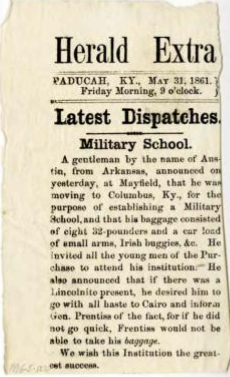
Though the state’s factions did share in a love for the Commonwealth, intrigue festered into the actions by those in favor of Unionism and those pushing for secession. During the Mayfield Convention, a gentleman known as “Colonel” Austin, proposed a plan to fill important positions in Kentucky with Southerners without breaking the state’s neutrality. Military schools should be established and filled with new students. He reckoned that 6-10,000 Southern men would be in Kentucky under the scheme, as the argument to be made was that it was their right to do so. “Individuals had a right to form for their own benefit as many military schools and accumulate arms and practice the arts of war as much as they desire, by the laws of Kentucky.” The Paducah Herald published Austin’s plan and bragged that he intended to bring artillery consisting of eight 32-pounders and a railroad car full of small arms for his students, the young men of the Jackson Purchase.[6]
Others were less enthused with the plan, even secessionists. Magoffin’s eyes and ears in Paducah, John M. Johnson, sent the governor an urgent message with a copy of the Herald’s story. He had information that up to 400 men were poised to enter Kentucky from Tennessee and occupy Columbus, though Gen. Pillow refused to allow them to do so. Johnson wrote that these men disbanded and approached the border as an armed mob under no one’s authority except Austin. This “band of plunderers and Hessians” had already destroyed one railroad car to pieces and fought each other numerous times, and “feared they will fight under no flag, without the privilege of robbing and plundering as they go.” The Louisville Daily Journal, the state's Unionist paper, seethed at the obvious ruse concocted by Austin. “Is that the secret plan we have heard so much about for bringing on a collision and hurrying Kentucky out of the Union? Is the work to be done by the bringing of a Tennessee army with Tennessee cannon and rifles into Kentucky upon the pretext of establishing a military school? OUT upon the vile knaves, fools, dastards, ruffians, who contemplate this outrage!” They questioned whether Magoffin and “his secession friends” would be as outraged by this clear violation of neutrality as they were over the faintest rumor of Federal movements. As events came to show, the answer was yes.[7]

Colonel Tilghman intended to stop this invasion, military school or not, and marched his State Guard toward the border. Johnson told Magoffin that Tilghman intended to have the mob “driven back” and that there was no solution but to “shoot them.” Rumors of this plan permeated the region, as Johnson traveled to Nashville a few days prior to speak to Gov. Harris about the matter. Harris assured him that Tennessee was anxious for Kentucky to know that these men were beyond their control and that the camp at Union City was strictly defensive and invited Johnson to visit the camp and see for himself. The governor reiterated his pledge to respect Kentucky’s neutrality and that his forces would only enter the state if called upon by the constituted authorities of the Commonwealth.[8]
In a flurry of travel, Johnson arrived in Paducah the following day and immediately boarded the train for the Tennessee border at Fulton Station. At Fulton and waiting for the morning train to take him to Union City, a man informed Johnson that “something unusual was going on.” A large body of men planned to enter Kentucky and march on Columbus and fortify the place. Another witness corroborated the story and said the cannon and small arms had come up from Memphis, the same place as Austin. Johnson rushed a note to Gen. Benjamin Cheatham to inform him of this plan and returned to Mayfield for the convention. Shortly after the conclusion of the events in Mayfield, and learning more of Austin’s scheme, Johnson met Cheatham in person in Union City. The general satisfied Johnson by informing him that no Tennessee forces would be allowed to cross the border into Kentucky.[9]
The plan to not-so-subtly subvert Kentucky’s neutrality by “Colonel” Austin fell apart quickly. Cheatham squashed the mob and the effort proved to be a failure. Along with Cheatham’s actions, Tilghman, though a secessionist, had done what he was supposed to do as an officer in the Kentucky State Guard--protect Kentucky’s sovereignty. If the mob had crossed the state line, Tilghman would have met them and the first shots in Kentucky would have occurred along the border with Tennessee.[10]

Derrick Lindow is an author, historian, teacher, and creator of the WTCW site. His first book, published by Savas Beatie, was released in Spring 2024. Go HERE to read more posts by Derrick and HERE to visit his personal page. Follow Derrick on different social media platforms (Instagram and Twitter) to get more Western Theater and Kentucky Civil War Content.
Notes:
[1] James W. Finck, Divided Loyalties: Kentucky’s Struggle for Armed Neutrality in the Civil War, 137; Berry F. Craig, “The Jackson Purchase Considers Secession: The 1861 Mayfield Convention, he Register of the Kentucky Historical Society, Vol. 99, No. 4, 344-346; J. Campbell to Beriah Magoffin, 1861-06-02, Office of the Governor, Beriah Magoffin: Governor's Official Correspondence File, Military Correspondence, 1859-1862, Kentucky Department for Libraries and Archives. Accessed via the Civil War Governors of Kentucky Digital Documentary Edition.
[2] “Secession Movements," Louisville Daily Courier, June 6, 1861, 2; June 6, 1861, 3. The records and minutes of the convention were lost and the best transcription of events is found in this article of the Louisville paper filed by corespondent J. N. Beadles who witnessed the event.
[3] The Louisville Daily Journal, June 6, 1861, 3.
[4] J. Campbell to Beriah Magoffin, 1861-06-02.
[5] Finck, Divided Loyalties, 137; “The Late Meeting at Mayfield,” Louisville Daily Courier, June 5, 1861, 1.
[6] The Louisville Daily Journal, June 6, 1861, 3; Unknown, "Military School", 1861-05-31.
[7] The Louisville Daily Journal, June 6, 1861, 2-3; Unknown, "Military School", 1861-05-31; John M. Johnson to Beriah Magoffin, 1861-05-31.
[8] John A. Gardner to John M. Johnson, 1861-06-01; John M. Johnson to Beriah Magoffin, 1861-05-31; John M. Johnson to Beriah Magoffin, 1861-05-31 (Second letter of the day).
[9] John M. Johnson to Benjamin F. Cheatham, 1861-05-29; John M. Johnson to Beriah Magoffin, 1861-06-02; John M. Johnson to Beriah Magoffin, 1861-06-05.
[10] John M. Johnson to Beriah Magoffin, 1861-06-02; John M. Johnson to Beriah Magoffin, 1861-06-05.


Comments