


Why is it Called Fort Jones?

Camp Nelson National Monument consists of a line of earthworks built to defend the camp from Confederate incursions. The series of forts were named after various individuals who lost their lives during the course of the war. One of the forts, accessible today by walking trail, is named Fort Jones. Just who is this Jones?

History is often told through the movement of great armies, but its heart beats in the stories of individual sacrifice. One such story belongs to Colonel Frederick C. Jones, a man whose journey began in the quiet countryside of Pennsylvania, flourished in the bustling streets of pre-war Cincinnati, and ended in a blaze of heroism on the banks of Stones River. His legacy, carved into the earth at Camp Nelson’s Fort Jones and enshrined in the granite of Spring Grove Cemetery, remains a testament to a life defined by "dash, energy, and soldierly qualities."
Frederick C. Jones was not a native son of Ohio, though he would become one of her most devoted defenders. He was born on December 16, 1834, in Parrott’s Grove, Green County, Pennsylvania. His early years were spent amidst the rolling hills of the Keystone State, a setting that perhaps forged the resilience he would later display on the battlefield.
He remained in Pennsylvania until his twelfth year. In 1846, the Jones family undertook the migration westward, settling in Cincinnati, Ohio. This move marked the beginning of Frederick’s integration into the social and intellectual fabric of the "Queen City," which was then exploding into a major American metropolis.
Upon arriving in Cincinnati, Jones was immersed in the city's public school system, a path that would lead him to the highest levels of local education. He entered Central High School in 1848, showing an early aptitude for learning. Three years later, he advanced to Woodward High School, an institution that would later see its pupils sing at his memorial services. Jones was known as a defender for those classmates less able than he.
As he matured, Jones turned his sights toward the legal profession. He read law in the offices of King & Thompson, a prestigious firm of the era. His diligence paid off; after being admitted to the bar, he quickly gained the confidence of the electorate. He was elected prosecuting attorney of the Police Court by a large majority.
By 1861, Jones stood on the precipice of a brilliant civil career. He was a young man of intellect, professional success, and community standing. But when the clouds of secession gathered, he did not cling to his personal prospects. To Jones, the call of his country was synonymous with "the call of God".
Jones’s military career began with the same energy that characterized his legal practice. He first served as a captain and aide-de-camp to General Joshua H. Bates, assisting in the vital task of organizing state troops at Camp Dennison. This early administrative experience was crucial, but Jones was destined for field command.
Following the initial three-months' service, he entered the three-years' service as lieutenant-colonel of the Thirty-First Ohio Regiment. However, the exigencies of the war soon demanded his transfer. He was moved to the Twenty-Fourth Ohio Volunteer Infantry (O. V. I.), joining them at Camp Wickliffe, Kentucky, in December 1861, where the regiment was attached to the Tenth Brigade, Nelson’s Division.
The spring of 1862 brought the regiment into the crucible of combat. At the Battle of Pittsburg Landing (Shiloh), the Twenty-Fourth Ohio was thrown into the fray. On the first day, they arrived in time to help check the Confederate advance. On the second day, the regiment found itself the target of an attack by an entire enemy brigade. Under Jones’s leadership, they withstood the assault and eventually drove the enemy back. For his "coolness and bravery" during this baptism of fire, Lieutenant-Colonel Jones was commended and subsequently promoted to colonel.
Following Shiloh, Colonel Jones led his regiment through the arduous operations of the Western Theater. He was among the first to enter Corinth, Mississippi, during the siege and pursuit. When the tide of war shifted back toward Kentucky with Bragg’s invasion, Jones endured the "long, dispiriting march" to Louisville.
After the Confederates decided to withdrawal from the bluegrass Jones's leadership capabilities were further recognized during the march from Wild Cat, Kentucky, to Nashville, Tennessee. During this movement, which was essentially "almost one continuous skirmish," Colonel Jones commanded the Tenth Brigade. His handling of the brigade through this rugged terrain earned him the specific thanks of his superior officer and the admiration of every field officer under his command.
As 1862 drew to a close, the armies clashed in the cedar glades near Murfreesboro, Tennessee, at the Battle of Stones River. On December 31, Colonel Jones and the Twenty-Fourth Ohio were positioned on the front and left of the Union line.
In the afternoon, the Confederates launched a ferocious assault. Displaying the tactical discipline he had instilled in his men, Colonel Jones ordered the regiment to lie down and hold their fire. He waited until the enemy was at point-blank range. At his signal, the regiment rose, unleashing a deadly volley that staggered the attackers. Jones then ordered a charge, rushing forward with such impetus that they captured almost an entire Confederate regiment.
It was in this moment of triumph that tragedy struck. A ball hit Colonel Jones in the right side, passing entirely through his body. As he was being carried to the rear—a dangerous task that saw two of his bearers shot down—surgeons rushed to his aid. Jones, realizing the severity of his wound, waved them away with words that have echoed through the history of his regiment:
"I know it. I am dying now. Pay no attention to me, but look after my poor, wounded men. Your services will aid them more than they will me!".
Ten hours later, the gallant Colonel was dead.
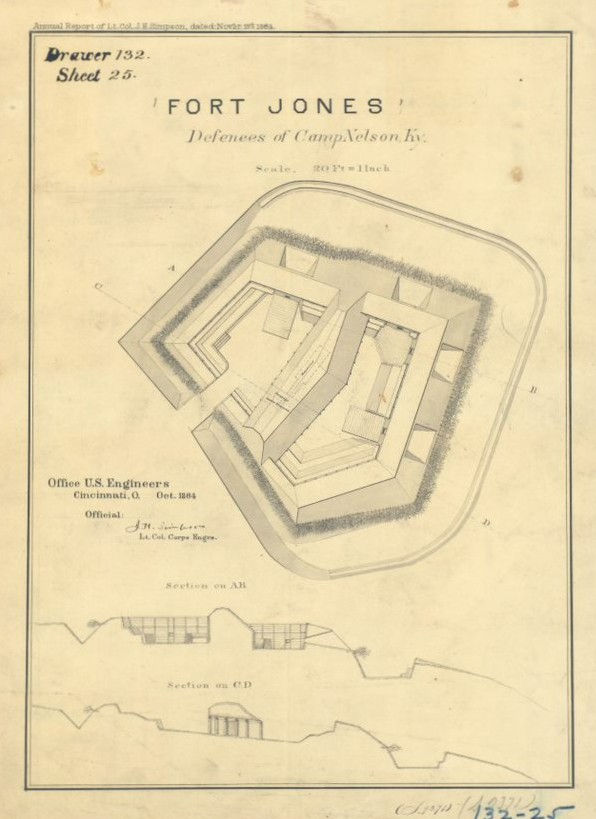
The memory of Colonel Jones did not fade with his burial. In 1863, the Union Army established a massive supply depot and recruitment center at Camp Nelson in Kentucky. To defend this critical position, a system of fortifications was constructed by Army engineers and enslaved laborers.
Defending the northern approaches, a formidable earthwork was raised and christened Fort Jones in honor of the fallen hero. This five-sided redoubt was a marvel of field engineering, designed with three artillery platforms and a deep ditch to break enemy assaults. It anchored the Hickman Creek Line, overlooking the valley to ensure no Confederate force could threaten the vital supply hub.
Though only earthworks remain today, Fort Jones stood as a silent sentinel, ensuring that the supply lines feeding the army Jones died for remained secure. It remains a physical reminder of the cost of the war, carved into the Kentucky landscape.
In the years following the war, the veterans of Cincinnati sought to preserve the bonds of fraternity forged in battle. In 1883, a movement began among the veterans residing on the hilltops of Cincinnati to establish a new post of the Grand Army of the Republic (G. A. R.). When it came time to select a name for this new organization, the choice was clear. They chose to commemorate the "gallant young soldier... who fell with a mortal wound... at Stone River".
Fred. C. Jones Post, No. 401, received its charter on October 23, 1883. It became a pillar of the community, noted for its charity and adherence to the principles of "Fraternity, Charity, and Loyalty." The Post raised significant funds for charity, disbursing money for coal, provisions, and medical assistance to indigent veterans, ensuring that the men who fought alongside Jones were not forgotten in their old age.
After his death, Colonel Jones’s remains were returned to the city he had called home. He was laid to rest in Spring Grove Cemetery, Cincinnati’s sprawling garden cemetery and a National Historic Landmark.
His grave is located within Section 21, a revered section of the cemetery where officers and enlisted men lie in concentric rings, symbolizing the unity of the army even in death. Unlike the grandiose monuments of politicians or industrialists, the markers here are often simple and uniform, reflecting the democratic nature of the volunteer army.
However, Jones’s resting place is a site of specific pilgrimage. For decades after the war, the members of the Fred C. Jones Post would march to Spring Grove on Decoration Day (Memorial Day). There, amidst the blooming dogwoods and silent magnolias, they would strew his grave with blossoms, recounting the story of the man who led them at Shiloh and died for them at Stones River.
It is a quiet, dignified end for a man of such "dash and energy," surrounded by the men he led and the country he saved.
Sources:
G.A.R. War Papers
Memorial Services at Memorial Hall
Spring Grove Cemetery Historical Records
Camp Nelson National Monument Archives


Comments